
Inégalités en science
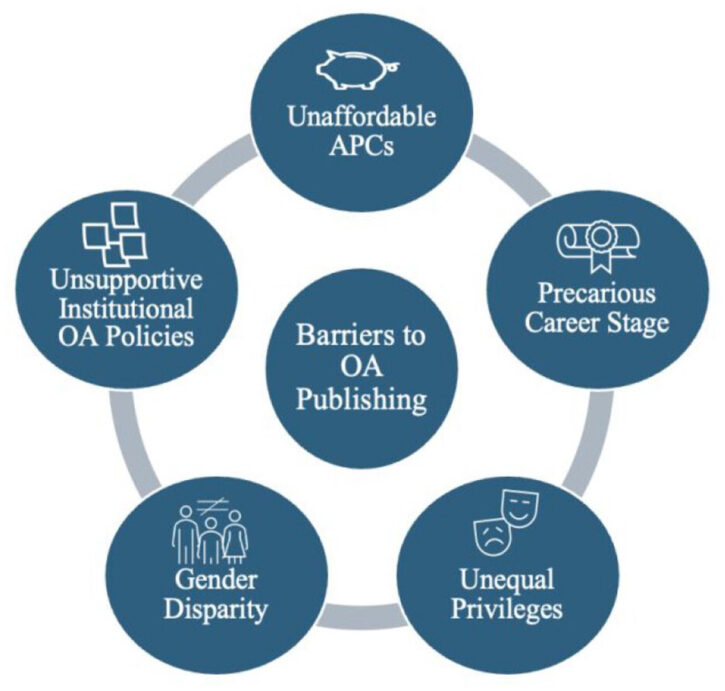
Inequity, Precarity, and Disparity: Exploring Systemic and Institutional Barriers in Open Access Publishing.
Despite increasing advocacy for open access (OA), its uptake in some disciplines has remained low. Existing studies have linked the low uptake of OA in the humanities and social sciences (HSS) to disciplinary norms, limited funding for article processing charges (APCs), and researchers’ preferences. However, there is a growing concern about inequity in the scholarly […] Lire la suite

Citation proximus: The role of social and semantic ties on citations.
Despite being considered as key indicators of research impact, citations are shaped by factors beyond intrinsic research quality—such as including prestige, social networks, and research topics. While the Matthew Effect explains how prestige accumulates, our study contextualizes this by showing that other mechanisms also play a role in citation accumulation. Analyzing a large dataset of […] Lire la suite
Understanding discrepancies in the coverage of OpenAlex: the case of China.
Citations indexes play a crucial role for understanding how science is produced,disseminated, and used. However, these databases often face a critical trade-off:those offering extensive and high-quality coverage are typically proprietary,whereas publicly accessible datasets frequently exhibit fragmented coverage andinconsistent data quality. OpenAlex was developed to address this challenge, pro-viding a freely available database with broad open […] Lire la suite
Scholarly publishing’s hidden diversity: How exclusive databases sustain the oligopoly of academic publishers
Abstract Global scholarly publishing has been dominated by a small number of publishers for several decades. This paper revisits the data on corporate control of scholarly publishing by analyzing the relative shares of scholarly journals and articles published by the major publishers and the “long tail” of smaller, independent publishers, using Dimensions and Web of […] Lire la suite

Applying an Intersectional Lens to Author Composition at Women’s Colleges, Historically Black Colleges and Universities, and Hispanic Serving Institutions in the United States.
Our analysis reinforces the overrepresentation of White authors across institution types, even within those with missions or threshold-based criteria that primarily serve a non-White student population. The most striking observation from our institutional analysis was the proportional overrepresentation of White and Asian men and women as published authors at HBCUs. This statistic raises questions regarding […] Lire la suite

The Howard-Harvard effect: Institutional reproduction of intersectional inequalities
The production of research and faculty in the US higher education system is concentrated within a few institutions. Concentration of research and resources affects minoritized scholars and the topics with which they are disproportionately associated. This paper examines topical alignment between institutions and authors of varying intersectional identities, and the relationship between research topics and […] Lire la suite
Avoiding bias when inferring race using name-based approaches.
Racial disparity in academia is a widely acknowledged problem. The quantitative understanding of racial-based systemic inequalities is an important step towards a more equitable research system. However, because of the lack of robust information on authors’ race, few large-scale analyses have been performed on this topic. Algorithmic approaches offer one solution, using known information about […] Lire la suite